
Diesel car guide
Updated: Aug 31
Written by: Rangicars
Date updated: 22nd August 2026
What are diesel cars?
Diesel cars are internal combustion engine (ICE) cars that rely on fossil fuels in order to run. An engine (the big metal block under the bonnet) mixes the fuel (diesel) with oxygen (air), makes an ‘explosion’ to make the car move. When it comes to diesel cars, most of their power and torque respectively are found lower down the rev-range (usually no more than 2,000rpm). This means that diesel-powered cars don’t need to be driven hard in order to make sufficient progress (Gibson, 2020; Hill, 2024; King, 2025).
What are its CO2 emissions?
As a general rule of thumb, diesel CO2 emissions are lower than petrol CO2 emissions. Nevertheless, diesel emissions still vary widely from model to model. There has never been a zero-emission diesel car as the very nature of internal combustion produces waste gases (CO2) which comes out of a tailpipe (typically found at the very back of a car). In the UK, cars were only officially measured to legal emissions standards since 1992. So any car before this time would likely have gargantuan emissions – certainly any cars before 1980, at the very least (AA, 2017; Gibson, 2020; Hill, 2024; King, 2025).
Given that diesel cars produce lower emissions than petrol cars, it is more likely that a diesel car with official ULEZ exemptions really are lower emission vehicles in the real world than petrol cars. However, diesel cars emit a particular type of particulate which petrol cars (typically) do not. This means that officially, only Euro 6 diesel cars receive ULEZ-exempt status (Gibson, 2020; Hill, 2024; King, 2025; VCA, 2026).
But what is the accurate way of ascertaining how environmentally damaging my vehicle really is? What does this measurement look like? How do I apply it to my car?
ULEZ-exempt status should not be viewed as a completely accurate measure of a diesel car’s low-emission credentials. In the same way that there are certain diesel models that actually return substantial CO2 emissions despite their so-called ULEZ-status, there are certain diesel models to which this principle can be applied, as well. For example, the 2020 Skoda Superb Estate 2.0 TDI CR 200 SE L 4X4 5dr DSG emits a fairly-large 156g-164g of CO2 per km (AA, 2017; Gibson, 2020; Hill, 2024; King, 2025; Parkers, 2020).
If environmental impact is of paramount importance to you when it comes to driving in ULEZ zones on a regular basis, electric cars are the only truly-viable option. Even if the likes of plug-in hybrid cars really did return ultra-low emissions readings in the real world (e.g. 20g of CO2 per km), 20g would still be 20g too many. 20g is still toxic, poisonous air that would contribute (albeit, negligibly) to the contamination of the air that people in residential areas would breathe (AA, 2017; Gibson, 2020; Hill, 2024; King, 2025).
If one wants to accurately identify how environmentally damaging their vehicle is, they should refer to the car showroom emissions colour chart (see below). Please note that the colour-coded part of the chart is the important part. The technical purple part is not relevant to this guide.
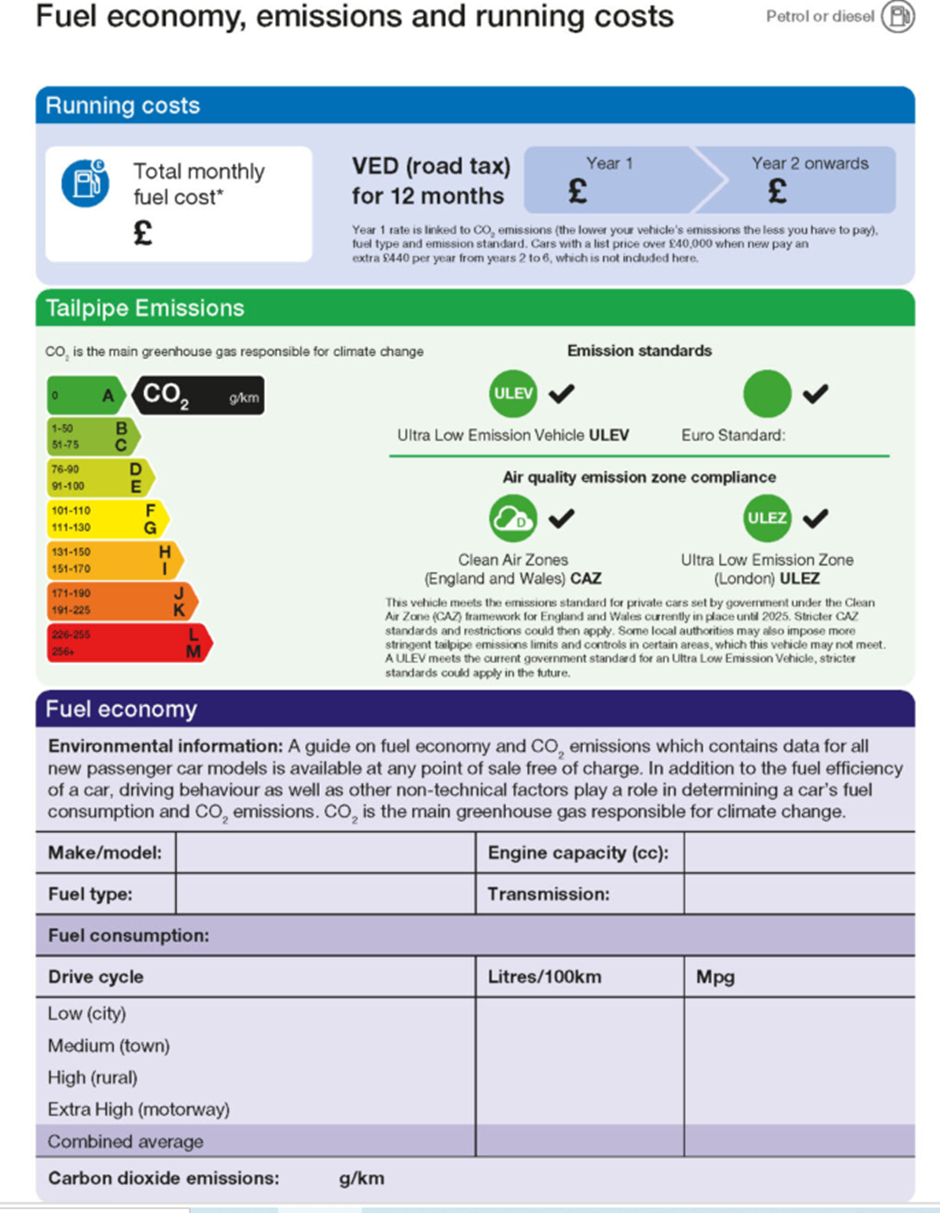
Source: VCA (2026). Car showroom emissions colour chart (petrol and diesel, respectively)
Can diesel cars go far on a full tank of petrol (real-world range on combined cycle)?
Yes, very much so. For instance, the 2014 BMW 520d (190bhp) SE 4d Step Auto (saloon) has a diesel-powered engine, which is generally more economical than petrol. On the other hand, it has an automatic gearbox, which is generally not as economical as a manual gearbox. Nevertheless, according to CAR Magazine, the BMW has a real-world range (combined) of 630 miles (Parkers, 2016; Taylor, 2015).
How do I decide whether or not diesel cars would fit around my particular lifestyle?
It depends on where you live. For instance, if you live in an urban area (town centre) or a suburban area (town outskirts/suburbs) then a petrol station (don’t worry, petrol stations generally sell diesel too!) should be within three miles of where you live. If you live in the middle of nowhere and a petrol station is 50 miles away from you, it may be less viable for you.
If you decided that diesel wouldn't be feasible, then perhaps the best course of action might be to buy a fully-electric car - but ONLY if you have a home EV-charger installed to your property WITH a fixed rate EV electricity tariff. Home EV-chargers vary in price depending on their maximum charging capacity each hour (i.e. how much AC current can be charged per kWh). Alternatively, there are certain energy providers that will install a home EV-charger FOR FREE on the condition that you buy your EV from them (Intelligent EV, 2026; Save up to 40%, 2026; Zwicker et al., 2023).
However, a large proportion (if not, most) of the UK’s population live in big cities, towns or other suburbs, so diesel is very much a viable option for them. If this applies to you, then diesel should absolutely fit around your lifestyle (Zwicker et al., 2023).


Comments